

Best Mid-Sized Ford SUVs for Towing 5,000 lbs
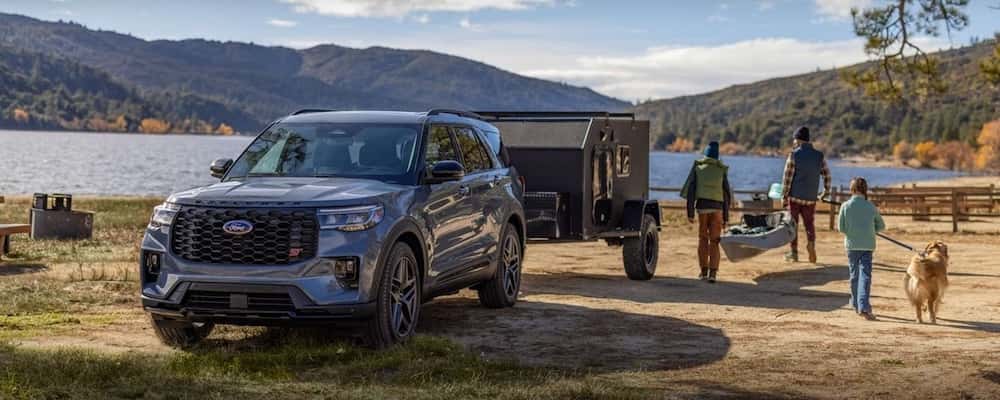
Towing 5,000 pounds isn’t extreme by truck standards, but finding a mid-size SUV that handles that load confidently takes more than a quick glance at a spec sheet. You need something that manages the weight without turning every highway on-ramp into an anxiety spiral, while still feeling normal on a Tuesday morning school run. For drivers in the Inland Northwest who want to know which Ford SUVs for towing 5,000 lbs actually deliver, we have a clear answer: the 2026 Ford Explorer. Browse our new vehicle inventory to see what’s available, or keep reading to understand exactly why the Explorer earns that recommendation.
Why Tow Rating Alone Doesn’t Tell the Full Story
Every vehicle shopper eventually finds the tow rating number, and it feels like the answer. It isn’t. That number represents the maximum a vehicle can pull under ideal conditions, with specific configurations, minimal passengers, and a properly set up trailer. The moment you add two adults, a cooler, and camping gear to your Explorer, the practical tow limit shifts.
Ford tow ratings are carefully engineered figures that account for engine output, transmission capability, frame strength, and braking performance. But real-world towing depends on how those elements work together under load. A well-designed towing package, the right engine matched to the right drivetrain, and a properly distributed trailer all shape the experience in ways a single number can’t capture. Buyers who understand this tend to make smarter choices, and tow more safely.
Which Mid-Size Ford SUVs Can Actually Tow 5,000 lbs?
Among current mid-size Ford SUVs, the 2026 Ford Explorer is the only model that reaches the 5,000-lb threshold. Other Ford models fall noticeably short. The Bronco tops out at 4,500 lbs on the Raptor and drops to 3,500 lbs on standard trims. The Escape maxes out at 3,500 lbs only with the 2.0L EcoBoost engine and optional Class II Trailer Tow Package, while hybrid and plug-in hybrid configurations are limited to 1,500 lbs. The Edge was discontinued after MY2024 and is no longer part of the current lineup.
The Explorer’s advantage comes from its available engine options, integrated towing hardware, and a purpose-built towing package that comes standard across all trims. It’s designed with family hauling and weekend towing in mind, which makes it a natural fit for drivers who don’t want to compromise in either direction.
2026 Ford Explorer Towing Capacity: What Every Trim Delivers
The 2026 Ford Explorer gives buyers multiple entry points into serious towing capability. Every trim in the lineup arrives ready to pull a significant load, no special-order add-ons required. Understanding what each trim brings helps buyers avoid both overspending and undershooting their actual needs.
Explorer Trim Lineup and the Standard Class III Tow Package
All five 2026 Explorer trims (Active, ST-Line, Tremor, Platinum, and ST) come standard with the Class III Tow Package. That package includes a Class III hitch receiver, seven-wire harness, four- and seven-pin connectors, trailer sway control, and tow/haul mode. No additional package is required to reach the 5,000-lb rating.
Trailer sway control is particularly valuable because it uses the vehicle’s braking system to actively stabilize a swaying trailer before the driver has time to react. Tow/haul mode adjusts shift points to maintain power on grades and reduce transmission wear under load. For buyers comparing Ford SUVs for towing 5,000 lbs, having all of this included rather than optional makes the Explorer a practical, cost-effective choice right from the start.
How Engine Configuration Affects Your Tow Rating
Engine selection plays a direct role in the Explorer’s maximum towing capacity. The 2.3L EcoBoost I-4 delivers capable performance for everyday towing, balancing fuel efficiency with enough torque to pull a loaded trailer without strain. The 3.0L EcoBoost V6 unlocks meaningfully higher output (400 hp vs. 300 hp) for buyers who regularly tow toward the upper limit or tackle sustained grades. Both engines pair with a ten-speed automatic transmission that maintains consistent power delivery under load. Worth noting: both RWD and AWD configurations deliver the same 5,000-lb max tow rating when properly equipped.
The Real-World Factors That Determine How Much You Can Actually Tow
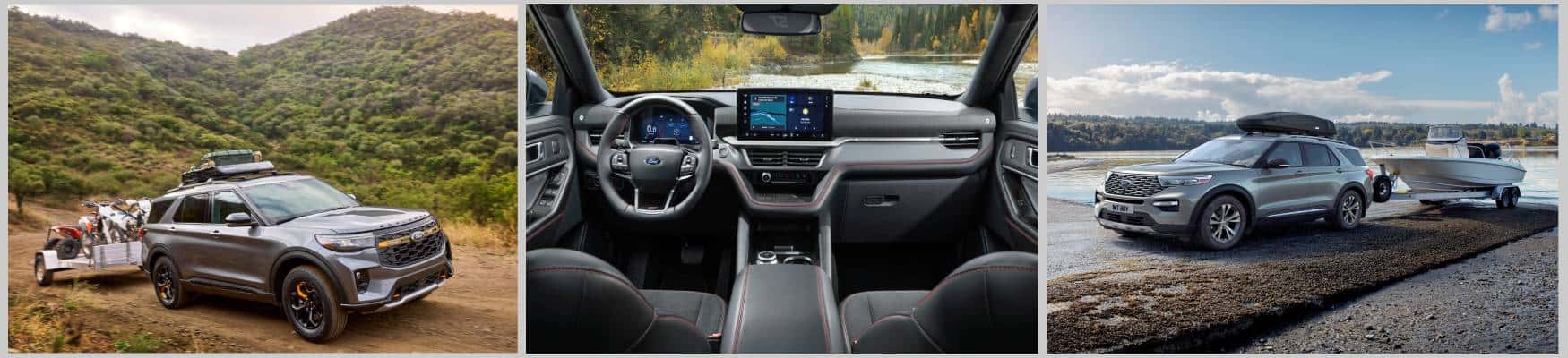
Knowing the Explorer’s rated capacity is a starting point, not a finish line. What you can safely tow shifts every time you load up the vehicle, depending on variables that are easy to overlook until you’re already on the road.
Payload, GCWR, and Cargo Load
Ford payload capacity covers the total weight the Explorer can carry on top of its own curb weight: passengers, cargo, and trailer tongue weight combined. Every pound added inside the vehicle reduces the available trailer weight behind it. A family of four heading to a campsite already puts several hundred pounds into the payload equation before anything goes into the cargo area.
The Gross Combined Weight Rating (GCWR) sets the absolute ceiling for the combined weight of the vehicle, passengers, cargo, and trailer. Staying within that number protects the drivetrain, brakes, and everyone sharing the road. Calculating the full load before departure, rather than estimating at the boat launch, is always the right call.
Tongue Weight, Sway Control, and Frontal Area
Tongue weight (the downward force the trailer exerts on the hitch ball) should sit between 10 and 15 percent of the total trailer weight for stable handling. The Explorer’s maximum tongue weight is 500 lbs. Running outside that range, whether too light or too heavy, compromises stability, especially at highway speeds.
Trailer sway control activates automatically, but improper weight distribution can still create handling issues. Packing the trailer so more weight sits forward of the trailer axle, and confirming the hitch ball and receiver are properly rated, makes sway control a safety net rather than a first line of defense.
The trailer’s frontal area should not exceed 40 sq. ft. Larger profiles increase aerodynamic drag significantly, cutting fuel economy and adding drivetrain stress on long hauls.
One more note on ratings: Ford uses the SAE J2807 towing methodology, which assumes a 150-lb driver and passenger under ideal conditions. Real-world loads vary. Actual towing capacity depends on vehicle configuration, load distribution, and driving conditions, and we encourage buyers to work through those numbers with us before finalizing a trailer purchase.
Towing Scenarios the Explorer Handles Around the Inland Northwest
The Inland Northwest gives Explorer owners plenty of reasons to use their towing capability regularly. A midsize bass boat or lighter pontoon headed to Lake Coeur d’Alene sits comfortably within the Explorer’s capability, particularly with the right engine configuration and the standard Class III Tow Package already in place.
Campers heading to Riverside State Park can tow a tent trailer or small travel trailer without the fatigue that comes from driving an oversized full-size SUV through Spokane traffic. For families hauling ATVs to Farragut State Park, the Tremor trim’s lifted suspension and all-terrain tires make a genuine difference on the uneven roads leading to remote trailheads. While the Tremor is standard with the 2.3L EcoBoost I-4, buyers can upgrade to the 3.0L EcoBoost V6 for additional towing power on rough terrain if needed.
The Explorer handles these loads without requiring a full-size truck, which most families appreciate when that same vehicle covers the daily school run the rest of the week. That kind of year-round versatility is what keeps the Explorer relevant for buyers who want one vehicle that earns its keep in every season.
Matching the Right Explorer Trim to Your Towing Needs
Not every Explorer buyer needs the V6, and not every buyer can get away with the I-4. Matching the trim to your actual towing use saves money and avoids arriving underpowered for the loads you regularly pull.
| Trim | Engine | Best For |
| Active / ST-Line | 2.3L EcoBoost I-4 | Daily driving plus light trailers, utility haulers |
| Tremor | 2.3L EcoBoost I-4 (standard) or 3.0L EcoBoost V6 (available) | Rugged terrain towing, remote Inland Northwest sites |
| Platinum / ST | 2.3L EcoBoost I-4 (standard) or 3.0L EcoBoost V6 (available) | Maximum power, performance-focused towing |
Note: RWD is standard; AWD is available across trims. Both configurations deliver the same 5,000-lb max tow rating when properly equipped.
Think through how often you tow, what you typically pull, and whether your routes include mountain passes or flat highways. Those answers will point clearly toward which Explorer trim earns its price for your specific situation.
Talk to the Towing Experts at Wendle Ford
Our Recommendation
For Inland Northwest families who need serious towing capability without stepping up to a full-size SUV, the 2026 Ford Explorer is the smart mid-size choice. It’s the only current mid-size Ford that reaches 5,000 lbs, it arrives with the right equipment standard across all trims, and it comes in a range of configurations that match real towing needs, from occasional utility hauling to regular weekend trips on rough terrain.
Get Personalized Guidance
Sorting out tow ratings, payload calculations, and trim comparisons online gives you a solid foundation, but there’s real value in talking through your specific situation with someone who knows the product line. We’ve been helping Spokane-area drivers find the right vehicle since 1943, and our team understands what Inland Northwest drivers actually use their SUVs for.
When you’re ready to move from research to a real conversation, contact our team for personalized towing guidance or to schedule a test drive. Finding the right Ford SUV for towing 5,000 lbs doesn’t have to be complicated, and we’re here to make that decision straightforward.
2026 Ford Explorer Towing FAQs
Do I need trailer brakes when towing with the 2026 Ford Explorer?
That depends on the trailer and your state’s requirements, but many trailers approaching the Explorer’s maximum towing range should have their own braking system. Trailer brakes can improve stopping control and reduce strain on the SUV during longer trips or downhill driving. Before towing, it’s smart to confirm your trailer setup, brake controller needs, and local towing laws.
Can I tow at the full 5,000-lb limit with passengers and cargo inside the Explorer?
Not always. Adding passengers, luggage, tools, or other cargo inside the Explorer affects payload and reduces how much trailer weight you can safely tow. To know your actual limit, you need to factor in passenger weight, cargo weight, and trailer tongue weight together.
What kind of trailer can a 2026 Ford Explorer realistically tow?
A properly equipped 2026 Ford Explorer can handle many common recreational and utility trailers, including small travel trailers, pop-up campers, fishing boats, and ATV trailers. The right fit depends on the trailer’s loaded weight, frontal area, and tongue weight, not just the empty dry weight listed in a brochure. Checking the trailer’s real-world loaded weight is always the better move before you buy or tow.
Is a weight-distribution hitch necessary for the 2026 Ford Explorer?
Some trailer setups may benefit from a weight-distribution hitch, especially when towing heavier loads near the upper end of the Explorer’s capability. This type of hitch can help improve balance, stability, and overall handling. The best choice depends on your trailer size, tongue weight, and how often you plan to tow.
How can I tell if my trailer is loaded correctly behind a Ford Explorer?
A properly loaded trailer should have balanced cargo and a tongue weight that stays within the recommended range for stable towing. Too much weight at the rear of the trailer can increase sway, while too much weight at the hitch can affect handling and braking. If you’re unsure, our team can help you review your setup before you head out.
0 comment(s) so far on Best Mid-Sized Ford SUVs for Towing 5,000 lbs