

Ford Truck Cab and Bed Combinations That Make Sense for Spokane Contractors
Picking the wrong truck configuration can cost a Spokane contractor serious money and time. Buy a bed that’s too short for lumber runs, or a cab that can’t seat your crew, and those problems don’t reveal themselves until after you’ve signed the paperwork. Getting the cab and bed combination right from the start determines how well that truck performs on the job.
At Wendle Ford, we work with contractors across the Inland Northwest every week, and we’ve put together this guide to help you find the best Ford truck cab and bed combinations for your trade before you ever set foot on the lot. Browse our current inventory or read on for the breakdown.
Why Cab and Bed Combinations Are the Most Important Truck Decision Spokane Contractors Make
Most contractors spend hours comparing engines and towing specs, but the best Ford truck cab and bed combinations come down to something simpler: daily work requirements. The cab dictates how many people fit inside and how comfortable they are on long drives between job sites. The bed determines what you can haul, how long those materials can be, and whether you’ll need a trailer for every job or just the big ones.
These two decisions work together and aren’t interchangeable. A SuperCrew cab shortens your available bed length. A Regular Cab opens up your longest bed options. Choose without thinking through both variables and you might end up with a truck that seats four comfortably but can’t carry 16-foot studs flat. Contractors in Spokane’s active trades market need a truck that solves a real operational problem.
Ford Truck Cab Options: What Each Configuration Means on the Job
Ford offers three distinct cab configurations across its truck lineup. Each setup changes the truck’s overall length, its weight distribution, and the bed lengths you can pair with it.
Regular Cab: Built for Solo Operators and Streamlined Work Rigs
The Regular Cab gives you two doors, no rear seat, and access to the longest bed options available. If your truck is primarily a hauling setup and you’re typically the only person in it, the Regular Cab keeps things lean and functional. Solo tradespeople and contractors who pull a trailer more often than they carry passengers will find this configuration works without compromise.
SuperCab: A Practical Middle Ground for Small Crews
The SuperCab adds rear-hinged back doors and a second row of seating. It won’t comfortably carry four full-sized adults on a long drive, but it gives a contractor meaningful space for a helper, an apprentice, or gear that shouldn’t ride in the bed.
For two-person crews working out of a single truck, it’s a configuration worth taking seriously. The SuperCab sits between the Regular Cab and the SuperCrew both physically and functionally — you don’t sacrifice as much bed length as you would with the SuperCrew, and you gain real-world utility over the Regular Cab.
SuperCrew: Full Crew Capacity Without Giving Up the Worksite
The SuperCrew brings four full doors and a true rear seat that can carry adults comfortably over long distances. This is the right cab for contractors who also use their truck as a family vehicle, or for foremen hauling a three- or four-person crew daily. The SuperCrew option spans the full lineup, covering the F-150 and Super Duty models, so you’re not giving up crew capacity when you step up to a heavier platform.
The main trade-off is bed length. Pairing a SuperCrew with a long bed creates a very long overall vehicle, which affects parking and maneuvering. Most SuperCrew buyers opt for the standard or short bed to keep overall length reasonable.
Ford Bed Sizes Broken Down for Real Work Scenarios
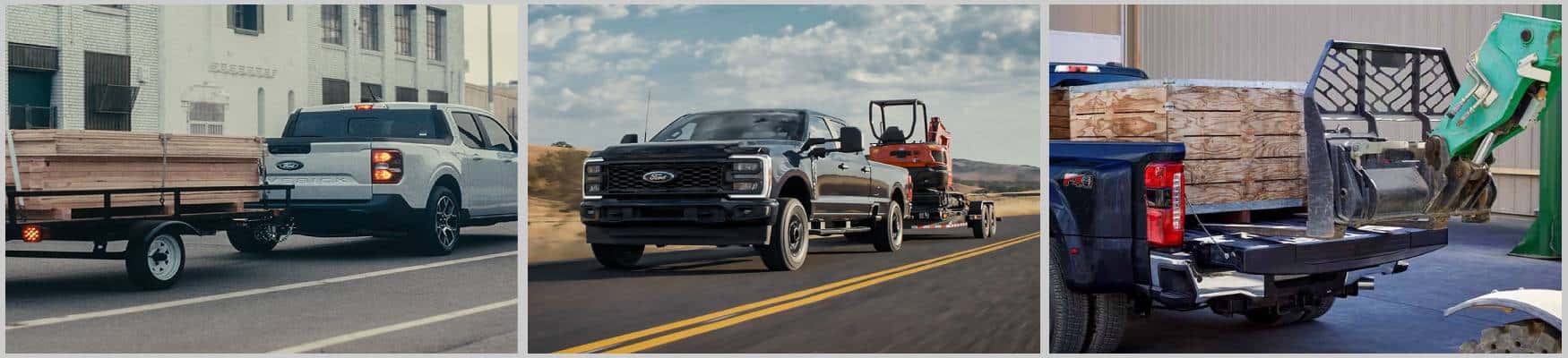
Ford offers three bed lengths across its truck lineup: the short bed at 5.5 ft, the standard bed at 6.5 ft, and the long bed at 8 ft. The right answer depends on what you’re regularly putting in the truck.
Short Bed (5.5 Feet): Maneuverability With Trade-Offs
The short bed keeps overall vehicle length down, which helps in urban environments, residential driveways, and packed job site parking. It pairs well with the SuperCrew for buyers who prioritize cabin space but still want cargo room. The limitation shows up when you try to carry sheet goods, long lumber, or pipe without a bed extender or trailer.
Contractors who routinely work with dimensional lumber or long conduit runs will find the short bed generates more friction than it’s worth.
Standard Bed (6.5 Feet): The Contractor Sweet Spot
The 6.5 ft bed is where most experienced buyers land for regular work use. It handles the majority of common construction and trade materials without excessive overhang, keeps overall truck length manageable, and pairs well with both the SuperCab and SuperCrew. An 8-foot piece of lumber fits with the tailgate closed, the bed accommodates standard pallets, and most tool storage solutions fit cleanly.
For contractors who need an everyday truck that handles varied tasks without requiring a trailer at every turn, this is typically the most practical choice.
Long Bed (8 Feet): When Maximum Haul Length Pays Off
The 8 ft long bed is purpose-built for contractors who move serious volume regularly. It handles full-length lumber, steel pipe, and large equipment without forcing a trailer for every run. The trade-off is overall vehicle length, which makes it more cumbersome in tighter spaces. It pairs most naturally with the Regular Cab or SuperCab.
Contractors who work on larger sites, do a lot of rural or highway driving, and need maximum one-trip hauling capacity will find the long bed pays for its inconveniences.
Matching Ford Cab and Bed Combinations to Common Spokane Trades
The best Ford truck cab and bed combinations aren’t universal. A configuration that works for a solo irrigation contractor is a mismatch for a framing crew running three people across multiple builds.
Landscaping, Concrete, and General Labor Crews
Landscaping and concrete contractors haul heavy bulk materials: soil, gravel, forms, and power equipment. Weight matters here more than length, so payload capacity often drives the decision. A Regular Cab with a long bed on a Super Duty platform can carry serious weight and still leave room for long-handled tools without needing a trailer every day. Small crews of two or three often prefer the SuperCab with a standard bed. It accommodates a helper, fits most residential driveways, and carries enough material for most jobs without towing.
Electrical, Plumbing, and HVAC Contractors
Trades that run conduit, copper, PVC pipe, and wire spools have a built-in need for bed length. An HVAC contractor loading ductwork or a plumber carrying 10-foot pipe runs needs at least a 6.5 ft bed, with the 8 ft long bed being the better call when runs exceed that regularly.
Electrical contractors working commercial jobs often carry an organized tool setup with a cap or utility body, which pairs well with a standard bed and SuperCab. This keeps the truck maneuverable in commercial corridors and parts warehouses while offering space for two-person teams.
Construction, Framing, and Multi-Site Operations
Framing and construction contractors deal with the widest range of material lengths and the heaviest daily loads. A Regular Cab with a long bed on a Super Duty handles full-length framing lumber flat in the bed and eliminates most overhang issues.
For foremen managing multi-site operations who need to move a crew between locations, a SuperCrew on the Super Duty with a standard bed makes more sense. You carry the crew, maintain high payload capacity, and still fit most dimensional lumber without a trailer on every run. Note that gooseneck and fifth-wheel hitch setups use usable bed space, which is worth factoring in when evaluating Chassis Cab upfit options for multi-site operators.
F-150 vs. Super Duty: Choosing the Right Platform for Your Load
Platform selection shapes what any cab and bed combination can actually do. We carry both lines, and a side-by-side look at the configurations contractors ask about most tells the story clearly:
The F-150 is the right platform for contractors whose jobs regularly involve light materials hauling, frequent highway driving, and towing in the range most residential trades require. When a job regularly pushes past what the F-150 can carry, Super Duty is the answer, not a preference. Its frame, suspension, and axle components are engineered for repetitive heavy-load use. Super Duty cab types mirror what’s available on the F-150, so you don’t give up configuration flexibility when you move to the heavier platform.
If you’re working through which platform fits your load, reach out to our team and we’ll help you run the numbers before you commit.
Spokane Conditions That Should Shape Your Configuration Choice
Spokane’s geography and climate create specific demands that don’t come up in a generic truck-buying conversation. Contractors working South Hill or subdivisions off Highway 195 deal with steep grades that test payload and towing capacity daily. Anyone running jobs east toward the agricultural flatlands or north into North Idaho needs a truck that handles both highway efficiency and occasional off-pavement site access. Mountain pass grades on routes to North Idaho job sites put real stress on the powertrain and payload. That’s where platform choice becomes a safety and reliability decision, not just a spec comparison.
Winter is the other major factor. Snow and ice arrive on a reliable schedule in the Inland Northwest, and early freezes are part of the deal. Heavier payload in the bed improves rear traction on icy roads, which is why experienced local contractors rarely buy the lightest possible configuration. A long bed carrying a toolbox or ballast weight over the rear axle is a practical February decision, not a secondary consideration.
Urban job sites in Spokane’s central neighborhoods present their own challenge. Older residential streets, narrow alleys, and tight parking near downtown projects make a shorter overall vehicle more practical than the maximum length. For contractors splitting time between tight city sites and open suburban or rural builds, the standard bed with a SuperCab often threads that needle more effectively than going to either extreme.
Talk to the Work Truck Team at Wendle Ford in Spokane
Our work truck team at Wendle Ford understands how Spokane contractors actually use their trucks. We’ll help you compare cab and bed configurations, review our current work truck inventory, and find a setup matched to your trade, crew size, and daily conditions.
Explore our current Ford truck inventory or contact our team directly to talk through which configuration makes sense for your operation. We’re here Tuesday through Saturday, 8 AM to 7 PM, and Sunday through Monday from 10 AM to 6 PM.
Frequently Asked Questions
What Ford truck cab is best for Spokane contractors?
The best Ford truck cab for Spokane contractors depends on crew size and daily use. Regular Cab works well for solo operators who prioritize bed length, SuperCab is a practical middle ground for two-person crews, and SuperCrew is best for contractors who regularly carry a full crew or also use the truck as a family vehicle.
What Ford truck bed size is best for contractor work?
The 6.5 ft standard bed is often the most practical Ford truck bed size for contractor work because it balances material hauling and overall truck length. The 5.5 ft short bed is easier to maneuver in tight areas, while the 8 ft long bed is better for contractors who regularly haul lumber, pipe, steel, equipment, or larger loads.
Should contractors choose a Ford F-150 or Super Duty?
Contractors should choose an F-150 when their work involves light-to-medium hauling, regular highway driving, and towing needs within the F-150 range. Super Duty is the better choice when a business regularly carries heavier payloads, tows larger trailers, or needs a truck built for repetitive heavy-load use.
Which Ford truck cab and bed combination is best for small crews?
A SuperCab with a 6.5 ft standard bed is a strong choice for many small contractor crews. It provides space for a helper or apprentice, keeps the truck more maneuverable than a full crew cab long bed, and still offers enough bed space for common tools, materials, and jobsite equipment.
0 comment(s) so far on Ford Truck Cab and Bed Combinations That Make Sense for Spokane Contractors