

What is Payload vs Towing Capacity on a Ford Truck?
If you’ve stood in a Ford truck lot trying to decide between an F-150 and a Super Duty, you’ve probably heard two numbers thrown around a lot: payload and towing capacity. They sound similar, but they answer completely different questions about what your truck can handle. Mixing them up can put you, your passengers, and everyone else on the road at risk. We put together this guide to walk through payload vs towing capacity in plain language, using verified Ford Motor Company figures, so you can read your own truck’s door sticker with confidence.
Payload vs Towing Capacity: Why Ford Truck Shoppers Get Confused
Most of the confusion comes down to marketing. Truck ads love to shout the biggest towing number on the window sticker, but that figure represents a best-case configuration, not necessarily the truck sitting on the lot. Payload capacity gets far less attention, even though it’s often the number that trips people up first. A truck advertised with a huge tow rating might have a fairly modest payload capacity once you factor in the specific cab, bed, and engine combination. Add passengers, a full tank of fuel, tools, and a hitch, and that “impressive” number shrinks fast. Understanding the difference from the start saves you from an unpleasant surprise later, whether you’re hauling gravel around Spokane Valley or loading up for a weekend at Priest Lake.
If you’re comparing configurations right now, it’s worth browsing our new Ford trucks or reaching out to contact our Ford truck specialists before you commit to a trim level.
What Is Payload Capacity on a Ford Truck?
Payload capacity is the maximum combined weight of everything you load into or onto the truck: passengers, cargo, gear, all of it. Ford Motor Company calculates it with a simple formula: Payload = GVWR (Gross Vehicle Weight Rating, the maximum total weight the truck is allowed to be) minus curb weight (the weight of the truck itself, with a full tank of fuel and factory equipment, but before you add anyone or anything to it). Whatever’s left between those two numbers is your usable payload.
What Counts Toward Payload: Passengers, Gear, and Tools
Everything that isn’t part of the factory-built truck counts against payload. Every passenger, every cooler, every bag of concrete, and every toolbox in the bed adds up, and aftermarket accessories count too. Add a 250-pound toolbox, a 75-pound bed liner, and a 60-pound tonneau cover, and that’s roughly 400 pounds gone from your payload budget before anyone even climbs into the cab. That’s an illustrative example, not a guaranteed spec, but it shows how fast upgrades and gear chip away at what’s left.
Finding Your Ford’s Payload Rating
Owner’s manuals and window stickers give general payload ranges, but the number that actually matters is on the yellow certification label located on the driver’s-side B-pillar door jamb. That label is federally required and reflects the as-built payload for that specific VIN, accounting for the exact cab, bed, engine, and options on that individual truck. Two F-150s on the same lot can have different payload ratings depending on how they’re equipped, so always check the sticker on the actual truck you’re buying rather than relying on a brochure number.
What Is Towing Capacity on a Ford Truck?
Towing capacity is how much weight the truck can safely pull behind it on a trailer. That number comes down mainly to engine output, transmission tuning, axle ratio, and frame strength. For the 2026 F-150, maximum available towing depends on engine choice: 8,400 pounds with the 2.7L EcoBoost V6, and a best-in-class 13,500 pounds with the 3.5L EcoBoost V6. The 3.5L PowerBoost Full Hybrid tops out at 12,400 pounds, while the 5.0L Ti-VCT V8 reaches 12,800 pounds. Horsepower and torque numbers get a lot of attention, but Ford Motor Company notes that horsepower, torque, payload, and towing are independent attributes and may not all be maximized simultaneously in the same configuration.
Finding Your Ford’s Tow Rating and GCWR Basics
Start with the same door-jamb label used for payload, then cross-reference the owner’s manual for your specific engine and axle setup. You’ll also want to know your GCWR, or Gross Combined Weight Rating, the maximum allowable weight of the truck, the trailer, and everything loaded into both, combined. Your truck’s actual weight plus your loaded trailer’s weight can never exceed the GCWR.
On the Super Duty lineup, this becomes especially important: the F-250 is rated for up to 22,000 pounds conventional towing and up to 23,000 pounds with a gooseneck when equipped with the 6.7L Power Stroke and the High-Capacity Axle Upgrade Package, and the full Super Duty range can reach up to 40,000 pounds on a gooseneck setup, 38,000 pounds fifth-wheel, or 30,000 pounds conventional. Those top-end figures come from the F-450 paired with the 6.7L High-Output Power Stroke diesel.
How Towing and Payload Affect Each Other
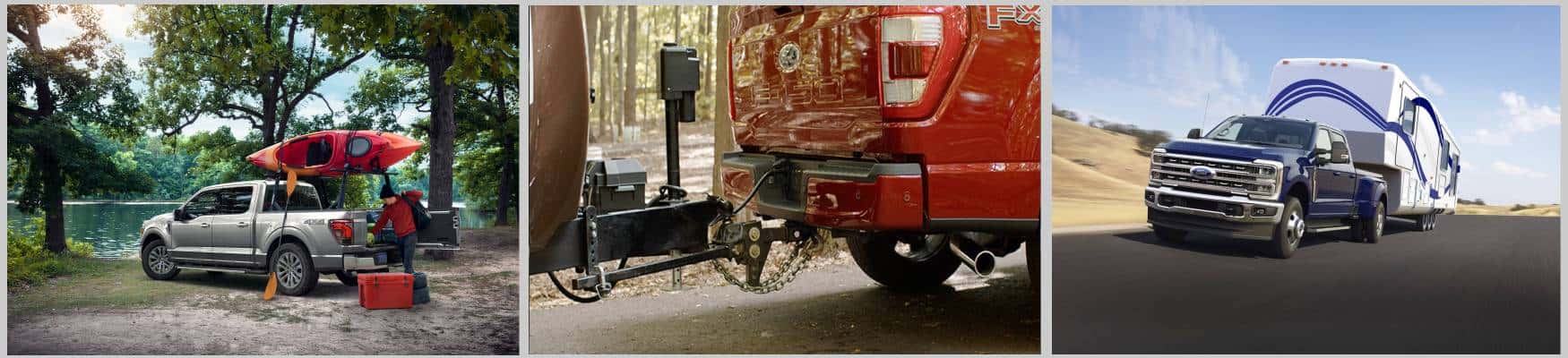
Towing and payload aren’t separate, siloed numbers, they interact constantly. When you hitch a trailer, part of that trailer’s weight presses down on your truck’s hitch, and that downward force, called tongue weight, counts directly against your payload capacity. That means a truck can be well within its towing capacity while still being overloaded on payload, simply because of what’s hitched behind it.
Tongue Weight: The Hidden Payload Eater
Tongue weight typically runs about 10% of a conventional trailer’s total loaded weight, or around 15% for fifth-wheel and gooseneck trailers. Say you’re pulling a 6,000-pound travel trailer at 12% tongue weight, that’s 720 pounds subtracted straight from your payload budget before you’ve packed a single cooler. That tongue weight also counts against your rear GAWR (Gross Axle Weight Rating, the maximum weight allowed on a single axle), so it’s an axle-loading issue as much as a payload one. Exceeding these numbers doesn’t just hurt performance, it affects braking, steering, and stability.
Real-World Example: Towing a Camper Through the Inland Northwest
Picture a family loading up an F-150 for a trip to Farragut State Park on Lake Pend Oreille, about 50 miles northeast of Spokane. The truck’s towing capacity looks great on paper, plenty of room for the camper they want to bring. But once you add the tongue weight of that camper, plus three passengers, a full cooler, and camp gear stacked in the bed, the payload side of the equation fills up fast, often well before the towing number becomes a concern. Generic towing content tends to skip this part: the towing max rarely stops the trip. Payload sneaks up first. That’s why we always encourage Spokane-area drivers to check both numbers, not just the one on the commercial.
Matching Your Ford Truck to Spokane-Area Jobs and Trips
The right truck setup really comes down to what you’re actually doing week to week. Someone hauling landscaping materials around Liberty Lake has different priorities than someone towing a boat to Coeur d’Alene on weekends.
Hauling Materials and Weekend Project Loads
For contractors, landscapers, and weekend DIYers hauling gravel, mulch, or lumber around the Spokane area, payload capacity deserves top billing. A loaded truck bed adds up quickly, and it’s easy to underestimate how much weight a few bags of concrete or a stack of decking boards actually add. If your work involves regular heavy loads in the bed rather than trailers, prioritize a truck configuration built around a strong payload rating, like Ford’s available Heavy-Duty Payload Package.
Towing Trailers, Boats, and Campers in the Region
If your typical weekend looks more like towing a boat to Lake Coeur d’Alene or a camper up toward Sandpoint, towing capacity and GCWR become your primary focus, along with a Max Trailer Tow Package if you’re regularly pulling heavier trailers. Just remember the payload interaction we covered above. It’s worth having your setup and specs reviewed before a big trip, and our service team is happy to help, or you can explore our used Ford truck inventory for configurations already set up for towing.
Choosing the Right Ford Truck Setup for Your Needs
There’s no single “best” truck for payload vs towing, it depends entirely on your own mix of jobs and trips. An F-150 with the 3.5L EcoBoost V6 might be plenty for weekend boating and occasional hauling. A contractor moving materials daily might lean toward the payload-focused end of the F-250 lineup, which offers up to 4,246 pounds max payload with the optional 7.3L gas V8. A larger operation hauling heavy equipment regularly might need the F-350 dual-rear-wheel configuration, with a best-in-class payload of up to 8,000 pounds.
Below is a side-by-side comparison showing how configuration changes both numbers. These figures are examples only, so always confirm your specific truck’s ratings on its door-jamb sticker.
Quick Checklist: Payload vs Towing Priorities
Before you settle on a configuration, run through this list:
-
Add up your typical passenger count and average cargo weight to estimate real-world payload use.
-
Calculate tongue weight for any trailer you plan to tow, roughly 10% conventional or 15% fifth-wheel/gooseneck.
-
Check the door-jamb certification label on the specific truck, not just the brochure number.
-
Confirm GCWR covers your truck’s weight plus a fully loaded trailer.
-
Factor in fuel, tools, and passengers together. Gear, a toolbox, and extra passengers can add up fast against your payload cap, so tally the specifics for your truck before you load up.
-
Ask about the Max Trailer Tow Package or Heavy-Duty Payload Package if your needs lean heavily one direction.
Get Expert Help from Wendle Ford
Talk to Our Team
Payload vs towing capacity isn’t something to guess at, and you don’t have to sort it out alone. Our team can go over your typical loads, trailers, and trips with you, and help match you with a Ford truck configuration that fits your needs, whether that means checking a door sticker together or comparing trims side by side. Contact our Ford truck specialists to talk through your specific needs, or start an auto financing application once you’ve found the right fit.
Family-Owned Since 1943
Wendle Ford has been family-owned and serving the Inland Northwest since 1943, and we’re located at 9000 N Division St in Spokane. Ford Motor Company designs and rates these trucks; we sell and service them, and we’re glad to help you make sense of both.
Frequently Asked Questions About Ford Truck Payload and Towing Capacity
What is the difference between payload and towing capacity?
Payload is the combined weight of the passengers, cargo, accessories, and trailer tongue weight carried by the truck. Towing capacity is the maximum weight the truck can safely pull behind it. A truck can remain within its towing limit while exceeding its payload rating, so both numbers must be checked.
Where can I find my Ford truck’s payload rating?
Check the yellow certification label on the driver’s-side B-pillar door jamb. It provides the payload information for that specific truck and accounts for its cab, bed, engine, and factory-installed options. The rating on the actual truck is more useful than a general maximum listed in a brochure.
Does trailer tongue weight count against payload capacity?
Yes. The weight pressing down on the hitch counts directly against the truck’s available payload and also affects the rear Gross Axle Weight Rating. Conventional trailer tongue weight is often about 10% of the loaded trailer weight, while fifth-wheel and gooseneck setups are commonly around 15%.
What is the maximum towing capacity of the 2026 Ford F-150?
The 2026 Ford F-150 can tow up to 13,500 pounds when properly equipped with the 3.5L EcoBoost V6 and Max Trailer Tow Package. Other engines and configurations have different ratings, so buyers should verify the towing limit for the specific truck they are considering.
0 comment(s) so far on What is Payload vs Towing Capacity on a Ford Truck?